**************************
Day 14
Monday, November 17
We have arrived in Antigua! We came in last night at 2330 h, making our voyage just shy of 14 days at sea, traveling 1730 nm after some of the zigs and zags needed to chase the wind and get out of the storm. The wind gods were good to us yesterday, allowing us to average 7 knots of boat speed. We arrived with 35 gallons of fuel – just under the extra 45 gallons Steve put in to the boat part way through our trip. Sooo glad he had the foresight to bring all those extra jerry cans.
Antigua and Barbuda are part of the British Commonwealth, and the formality of the British is already apparent, with dingy masters dressed in khakis and captain’s attire. English Harbor, where we are docked, was used as the headquarters of the British Royal Navy Caribbean fleet during the 18th Century, once commanded by the famous Admiral Horatio Nelson. We were greeted by a large battement that probably would have successfully pounded any potential invaders with cannon balls. Nelson’s Dockyard, where we are staying, is a UNESCO World Heritage Site. This afternoon, we were invited to attend a “tot” at the Royal Naval Tot Club of Antigua and Barbuda, They carry on the tradition every evening at 1800h to gather to consume a half gill (2 fluid ounces - the amount allotted to a sailor every day) of the rum that was consumed by the British Royal Navy. There is a reading of Naval history pertinent to that day and then a toast to the allegiance to the king.
It is great to finally feel land under our feet!
The Crew of Second Half
And Signing off by the Communications Officer - Out
**************************
Day 13
Sunday, November 16
Less than 24 hours to go! We should be there by early morning tomorrow. Huzzah!
There has been a question about whether or not we have enough fuel to continue motoring the whole rest of the way, since we continued to confront more adverse current with no to light winds. It was quite a sight to see the three geek heads, Steve, Randy, and Mark, discussing the trigonometry of sail angles and fuel burn rates to develop their estimates. I wish I had a recording of that conversation. We are expecting to be able to sail today, and made a blessing to the God of Wind, Helios, last night over dinner to bring us wind. We are very optimistic.
Now that the nastiness of the November 5th – 6th storm is well in the past, I thought I would tell you about that night, which I call the “Holy Moly” storm. Wind speeds were 30-35 knots into chaotic 12 foot seas. The highest wind gust for us was 47 knots (think of wind screeching along the foothills corridor at 54 mph). Our boat speed at one point reached a dangerous 18 knots. The wind in the shrouds sounded like Siberian huskies howling. I never knew the wind could actually howl like that before. When the boat would bury a hull in a wave, the hull on its opposite side would catch the spray with either the port (red) or starboard (green) navigation light making red or green arcs across the sky. The wind spilling through our door seams sounded like an old man breathing heavily. As I was seasick, I thought I was hallucinating.
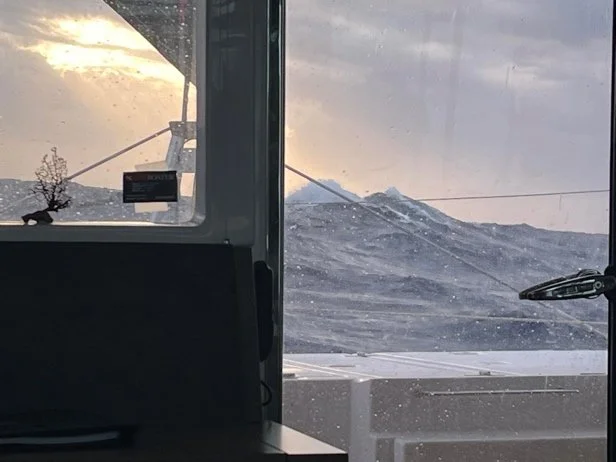
About ½ the boats split off after that storm to Bermuda for either repairs or refueling. Some of the damages included: cracked window in the head taking on water from a rogue wave, cracked boom, broken rudder post (connecting the steering wheel to the rudder so you can turn the boat), damage and loss of Starlink (critical for communication), jib halyard failure, ripped sails, broken autopilots, and more. There are stories of a boat doing 360 degree spin on top of a wave, with a crewmember novice to ocean crossings at the helm. One boat, named Magic Bus, not in our fleet but heading to Bermuda, sustained a leak in their sail drive and sank. Luckily, all five people aboard were rescued by the Coast Guard. Most of the boats that sustained heavy damage were to our north. We are grateful that Captain Steve made some wise choices to help guide us safely through the storm with his usual calm demeanor. The only damages to Second Half were a broken spice drawer when the latch shook off and a fouled head sail, which luckily Steve and Randy were able to retrieve before the worst of the storm hit. This just goes to show you that you need to have a healthy respect for the ocean and solid knowledge of how to navigate heavy weather, which is sometimes unavoidable on ocean passages. Photo below is of one of the waves after the worst of the storm was passing. It was dark when the storm was at its height.
Calm seas never made a good sailor.
The Crew of Second Half
**************************
Day 12
Saturday, November 15
When we are all asking – are we there, yet?
Well, navigating to favorable currents turned out to be a bust. We found the currents differed by 180° from our current map in some places. One of the members of our fleet posted in the discussion board that current models have too large an area of projection to reflect actual conditions for a specific area of the ocean and are particularly not accurate around the islands. He did say our current chart had pretty colors though, which some of you already remarked to me in private.
Anyways, it is a beautiful, sunny day and there is enough breeze finally to motor sail. It is good to hear the wind in our sails again.
You may be a sailor, or you may not be, but for me sailing on Second Half has been quite a trip just because she is chock full of equipment and luxuries. As Jen says, she is like a floating condominium. Here are some of her amenities:
Solar panels
Washer and dryer
Two refrigerators
Three freezers
Icemaker
Sodastream unit
Dishwasher
Watermaker – converts salt water to fresh
Generator
Inverter
Large screen TV for streaming
Spares for just about any mechanical failure we might encounter
Starlink
Predictwind Data hub and Garmin Inreach backup
Raymarine chart plotter running Navionics data – which I found out if you want to tack, you can just push the button (tack to starboard, or tack to port – whatever the case may be.
Sheesh. We are not lacking for comfort, even if it is taking us a bit longer than expected.
The Crew of Second Half
**************************
Day 11
Friday, November 14
The wind is light and we are facing an adverse current. It is hard to watch our ETA in Antigua continue to go up. It is now midnight on Sunday night. Salty Dawgs is hosting a party in English Harbour at 1630h on Sunday, and when Mark took over his watch, I told him to step it up so we could make the party – and he did! A squall hit us from behind – what I would describe as our perfect storm. No, not The Perfect Storm, like Sebastian Junger’s book, which has a bad connotation, but our perfect storm, which has a good connotation. The storm blew us from our quarter (ideal for speed) with 10’ following swells (pushing us even more along) and blowing as high as 27 knots. Under a head sail, we were soon sailing at speeds of up to 8 knots. Mark, a former sailboat racer, was gleeful. The storm was pushing us ahead as fast as it was moving, so it stayed with us for over an hour. Despite the downpour, we were all thankful for the push. Alas, we are still not expected to make it in time for the party.
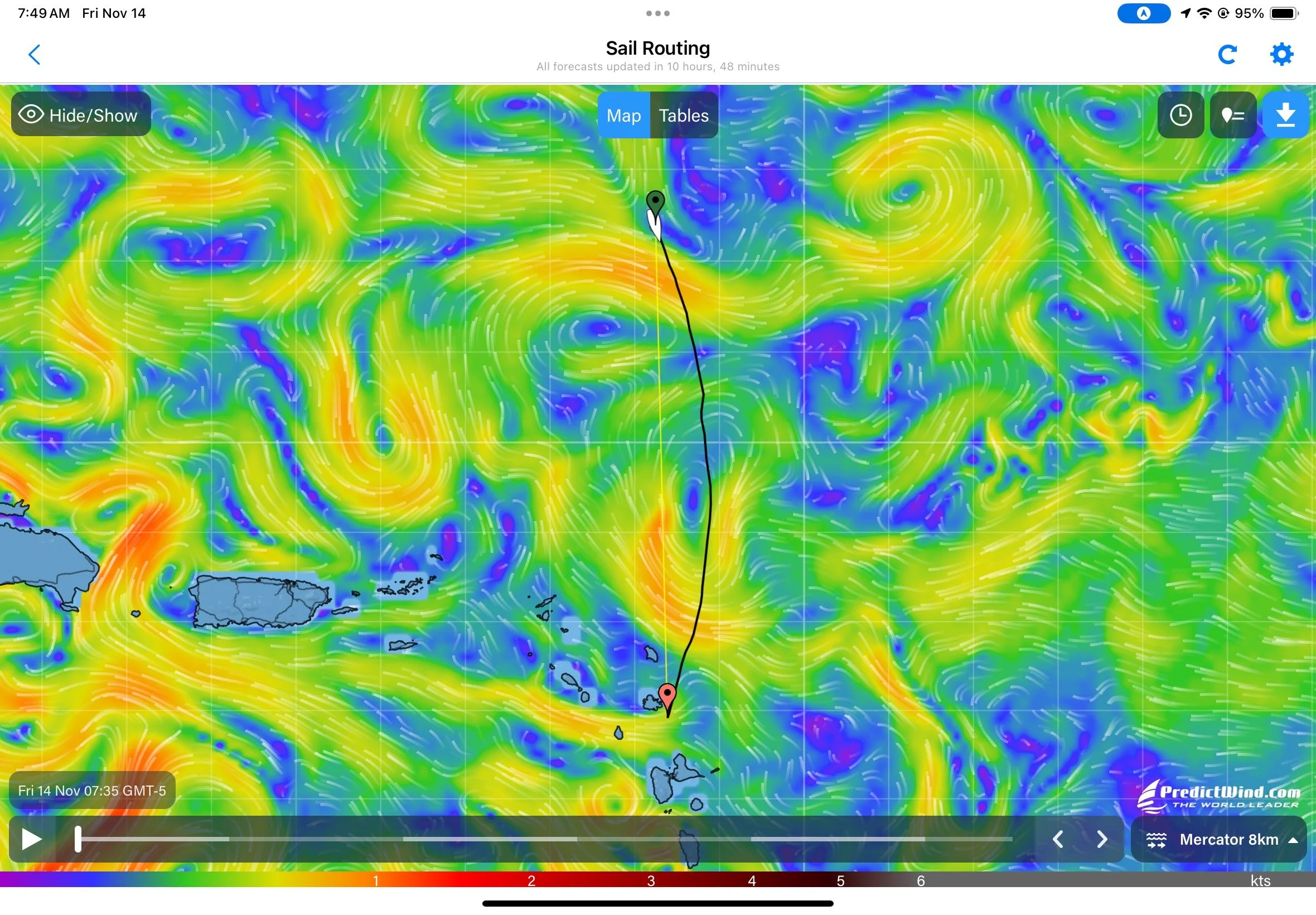
Steve has been looking at the currents in the area to try to maximize our route. There is a crazy mess of currents out here (see photo). So, he has put in a set of waypoints to bring us into favorable currents and keep us out of adverse currents whenever possible. We will see what happens.
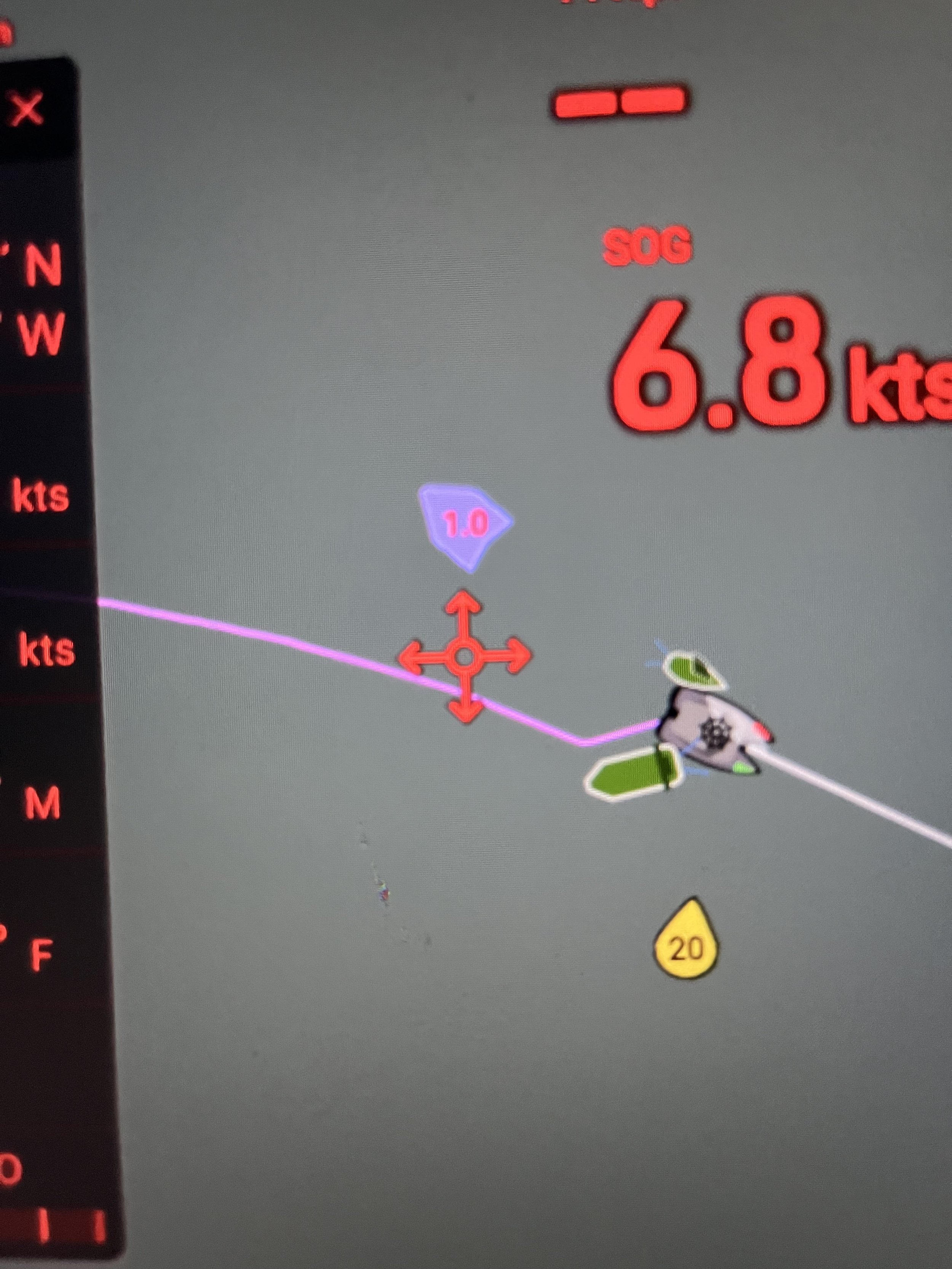
I thought I would spend some time today telling you about life aboard Second Half on an ocean passage. What dominates our life is our watch schedule. Each of us have 3-hour watches twice a day, followed by serving as back up for the next person on watch. In between each watch and back up period, we have 9 hours off, allowing us to catch some sleep and eat. As an example, mine was from 0300h to 0600h this morning, and it will be from 1800h to 2100h tonight. The rotation is as follows: Steve, Penny, Mark, Randy, then Jen. When we are on watch, we are at the helm responsible for steering (largely left up to the autopilot), making decisions about which sails to put up or take down, recognizing emergency situations and responding appropriately, and watching out for approaching storms and avoiding ships (see photo of a close encounter with an oil tanker at 0100h under one of my watches). The person who takes the watch starting at 1800h is responsible for cooking, and the person on backup is responsible for cleaning. Several times when dinner is ready, we let the person on the helm join us for dinner, turning off the engines and drifting, and we all sit down and eat together. We have had some wonderful dinners, including lots of fresh fish caught by Steve. It all has a very nice rhythm and allows us to be on watch at various times of day and night. If you are interested in knowing when the people you are following are on watch, now you can go ahead and calculate that!
The Crew of Second Half
**************************
Day 10
Thursday, November 13
We definitely have landed in a hole of no winds after the storm sucked all the energy from our current position north. If you look on our PredictWind tracker, you will see we are in this purple hole, with winds of 0-4 knots. Uggghhh. While it looks good further south now, this hole is expected to blossom, providing us with no winds for the remainder of the trip. One neat thing that happened was the storm pushed large swells southwards. Steve kept looking to see if he could see that wave front approaching, sort of like the incoming tides in the Bay of Fundy, but when they arrived, it was more subtle. We have been in 10’ swells that are evenly and widely spaced (12 sec) pushing us from behind that feels like we are rocking in a cradle. It was hard for me to stay awake on my watch last night with the rocking motion. Lullabies kept playing in my mind.
Around sunset, we are expected to cross the Tropic of Cancer, which marks the northern-most point where the sun can be directly overhead, and defines the northern boundary of the tropics. During the Summer Solstice, the sun is directly overhead at noon along that latitude. It was named the Tropic of Cancer 2000 years ago, because ancient astronomers noticed that the sun was located in the direction of the constellation of Cancer during the Summer Solstice there. Now during the Summer Solstice the sun is in the house of Taurus, so it more aptly should be called the Tropic of Taurus, an even better name because of its alliteration. Why is that the case, you may ask? The earth does not spin on a fixed access, but wobbles (a phenomenon known as precession). This wobbling motion causes variation in the celestial alignment – sort of like being on a boat and watching an object on the horizon move up and down due to wave action. Another notable fact about the Tropic of Cancer, is that it defines the southern limit of the mutual defense obligation for NATO member states. We will be on our own from there on, baby.
The Crew of Second Half
**************************
Day 9
Wednesday, November 12
Life after Salvation
We crossed the Line of Salvation at 1630h last night, a bit earlier than predicted. A round of cheer erupted on the boat. Huzzah! Now we are looking ahead to the rest of the voyage. We were lucky the winds held on, allowing us to continue to sail into the night S/SW curving around to our eventual rhumb line to the waypoint we call East of Barbuda. Once the winds died down, we started motor sailing to our destination.
One of the reasons why so many of our fleet members decided to head to Bermuda and wait several days rather than continuing to Antigua, as we opted to do, was this last powerful cold front was expected to suck the energy from the trade winds that are so reliable in this area. They are now predicting that we will not see enough wind for sailing for the rest of the trip. Now the question is, how much fuel will we need? Luckily Steve had the foresight to pack our boat with several extra containers of diesel, and he added another 45 gallons to our tanks while underway. Now, we expect to have ample fuel to motor all the way to Antigua with a couple days to spare. Huzzah again! Our latest expected day of arrival is this coming Sunday – 13 days overall.
With the winds and swell light, and the ocean temperature at 82 degrees, Steve, Jen, and Randy decided to go for a swim – in 20,000 feet of water, no boats in sight, and 500 nm from the nearest land. Penny and Mark were both too chicken. A refreshing break for some of the crew.
I thought I might tell you a little about the trade winds – that we are SUPPOSED to have, but have been sucked north.
The trades in the Atlantic are persistent (Ha! Ha!) winds that blow westward toward the Equator from the subtropical high-pressure belts. They typically blow at 10-20 knots, but can exceed 30 knots. They have been crucial for navigation and trade for both indigenous peoples and European colonizers, enabling voyages between the Americas, Africa, and Europe. Columbus used them in his “discoveries” of the new world, sighting and naming Antigua in his second voyage in 1493. In a more ugly chapter of human history, they facilitated the establishment of the triangular trade - bringing slaves to the Caribbean from Africa.
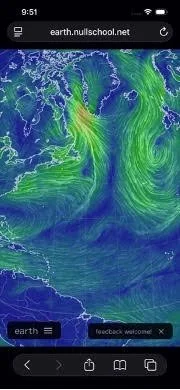
I will end today’s update with a photo showing the forces that are sucking the trade winds from this area. Pretty impressive, huh?
The Crew of Second Half
**************************
Day 8
Tuesday, November 11, 2025
First of all, on this Veterans’ Day, thanks to all the Veterans who follow us. Thank you for your service.
Last night offered up beautiful sailing with SW winds of 16-25 knots setting us right in the direction we want to go under a bright half-moon sky. To start out the evening, Steve caught the biggest Mahi ever hooked on Second Half – 46”. We will be eating fish tacos and ceviche for a while! The day promises to be just as beautiful as last night. We will be staying on this heading all day and into the evening.
Today, I want to talk about Salvation. What does salvation mean to you? To us it is a line we named Salvation formed by Chris Parker’s set of waypoints between 26°N 65°W and 28°N 62W. We need to be there by this evening. This will put us ahead of a nasty cold front pushing down from the NW. You may be reading about this where you are, as it is bringing snow far south and bringing nasty weather to the Atlantic Seaboard and Bermuda. For us this could mean it would be pushing swells of 12’ in front with high winds. We are currently at 27°52’N 63°41W and making good speed, although facing a strong current. We should be able to make it across that line by the evening with no problem. Here are snapshots from PredictWind of sailing in the front versus making it beyond the line of Salvation. Red is bad. Brown is downright ugly. Blue is beautiful. We are thankful to modern software and Chris Parker to keep us safe. Ancient mariners did not have access to these tools. It is no wonder so many ships were lost at sea in the old days.

The crew of Second Half
**************************
Day 7
Monday, November 10, 2025
Just under two glorious days of blue water sailing under blue skies and puffy clouds. We reached our halfway point yesterday evening – a cause for celebration. The Captain allowed us each a shot of rum after dining on freshly-caught Mahi. We turned off the engines and ate to complete quiet with just the rocking of the waves; the nearest land some 500+ miles away, more than a league of ocean beneath us, and no boats anywhere to be seen. Perfectly lovely. Today, we spotted the sails of one of our fleet members. When they were close enough to be “hull up” so to speak (close enough for us to see the hull of their boat above the waves), we hailed them on our radio. With that in mind, I thought you might be interested in some sailing terms that have come into popular use.
Most people know that three sheets to the wind refers to someone who is so drunk they can hardly stand. The term’s sailing origin refers to when three sheets (lines used to control the sails) are in the wind, sailors have lost control of the boat and it wanders about like a drunken person.
Also related to drinking, the term “grog” referred to the daily ration of watered-down rum for sailors. When sailors had a bit too much to drink, they would be “groggy”. While this may still be used for someone who drank too much, it is now mainly used for someone who is still half asleep in the morning, or disoriented.
At loose ends referred to when sailors would run out of tasks on board a ship, the captain might ask them to check the ends of ropes and make sure none of them had started to unravel. Now, you may find yourself at loose ends if you have run out of things to do and are unsure about what to do next.
Pipe down A boatswain or ‘bosun’ was a ship’s officer who was, amongst other duties, in charge of the crew. He would issue different orders to crew members by changing the sound patterns blown on his 'call', a sort of high-pitched whistle. 'Pipe down' was the last order of the day for off-duty crew to stop talking, settle down or go to bed. Today, the phrase 'pipe down' is still used to tell someone to be quiet.
Scuttle butt in common parlance refers to gossip. In sailing terms, it was a cask where sailors would gather for water and to exchange information – hence where rumors would start.
Showing someone the ropes is often used in business to show new people their job. For sailors, it was crucial to “know the ropes” on board a ship – and there would be a lot of ropes to know. For example, Admiral Lord Nelson’s HMS Victory required a staggering 26 miles of rigging. Knowing what each rope did and what it was connected to ensured a ship’s smooth operation.
Son of a gun was a baby born on board a ship, perhaps between the guns of a gun deck. Now son of a gun refers to a child of questionable parentage.
Taken aback used today to refers to being surprised or shocked by something unexpected. For sailors on square riggers, when the wind suddenly shifted and blew the square sails against the mast, it would halt forward progress, and make the boat unmanageable. The crew could be caught offguard and potentially the masts could break.
Under the weather – someone who was seasick and was sent below decks to get “under the weather” in order to get better.
Finally, as a reminder: You can track our boat’s progress and the wind conditions here.
You can track the progress of the Salty Dawgs fleet, and our boat here.
You can see photos of our voyage here.
And I have created a Google document with all of these communications so if you do not have time to read them when you get them, but want to catch up on them later, you can read them all here.
The Crew of SV Second Half
**************************
Day 6
Sunday, November 5
We are officially below 30°N, and in the tropics, baby! Finally seeing a warm sunny day. Once again, we made some navigational decisions that put us into a little finger of wind yesterday, while other boats surrounding us dropped into an area with no winds and were left far behind. Several of those boats decided to turn to go to Bermuda as they were making little headway south. We, on the other hand, had a great sailing day, lasting into the evening.
As you may have read from these updates, we have made several navigational decisions that put us in a better place than some of the fleet, and feel blessed to have strong guidance from our experienced Navigator, Captain, and First Mate. In addition, we rely heavily on modern software and personal guidance from a dedicated meteorologist, Chris Parker. The weather software we rely on most is called PredictWinds. You can see a snapshot of that with our boat track and position here. PredictWinds gives us high-resolution visuals on wind direction, speed, precipitation, wave height, sea surface temperature maps, ocean currents, and sea state. It allows us very detailed information in the area immediately surrounding our location as well as allowing us to zoom out to more global views and provides forecasts based on several models. Chris Parker is the chief forecaster for the Caribbean Weather Center and leads the Marine Weather Center. He was hired by the Salty Dawgs fleet to provide daily briefings and route guidance. He makes very specific recommendations about waypoints (places you want to get to) and timing with the aim of optimizing sailing time and getting everyone safely through bad weather, including highly localized squalls. In addition to these daily briefings, you can get a subscription to have personal chats with him about the best route for your specific boat. We are lucky that Captain Steve has such a subscription. While weather forecasting has become quite high tech, intersecting these various bits of information and advice also relies heavily on common sense, and our Navigator, Captain, and First Mate have made some calls based on the best of available data and their own knowledge that has allowed us to sail this voyage more expeditiously and safely. Right now, we are headed to the Chris Parker Magic Waypoint – were we might still see some tradewinds if we get there in time!
**************************
Day 5
Saturday, November 8.
Yesterday we had a major decision to make. Do we continue on our way south to Antigua or stop off in Bermuda to refuel. The typical trade winds that are so reliable were predicted to collapse, meaning we would have to motor many more days than planned. If you are watching the fleet tracker, you will see that a large number of boats decided to head to Bermuda to refuel or to fix mechanical or boat failures that occurred in our first big storm. Captain Steve calculated that we had enough fuel to motor all the way to Antigua if need be, so we headed on down. Today we are sailing with good winds.
We are currently in the area known as the Bermuda Triangle, or Devil’s triangle. This is loosely formed by drawing points between Bermuda and Puerto Rico then towards Miami. This has a reputation of being a region where a number of aircraft and ships disappeared under mysterious circumstances. Popular culture has attributed various disappearances to the paranormal or activity by extraterrestrial beings. Maybe, as Communications Officer charged with communicating with aliens, I can make contact. Documented evidence indicates that a significant percentage of the incidents were spurious, inaccurately reported, or embellished by later authors. According to the US Navy, the triangle does not exist, and the name is not recognized by the US Board on Geographic Names. It is a fun factoid, nevertheless.
The Crew of SV Second Half
**************************
Day 4
Good morning everyone,
For those of you who have been watching the fleet tracker, we split from the fleet to catch some winds further north and rejoined them again this morning. It is nice to see some sails around after about 500 nm of sailing in the middle of the ocean. Amazing how that happens. Last night’s moonrise was spectacular, and it looked just like the Second Half logo as it was rising – a good omen. We have had pretty fair weather for sailing these last 24 hours.
I wanted to introduce everyone to our crew today. We have a well-qualified, but very nerdy crew aboard SV Second Half. To underscore their nerdiness, I have identified members of the Star Trek fleet corresponding to each crew member’s position as I introduce them. (I also put up photos on our photo page here, that show who they are and their nerdiness.
Let’s start with Steve Konieczka (Captain – James T Kirk) and Jen McAdams (Medical Officer – Beverly Crusher). You can read more about them on the Second Half website here, but just a little synopsis. Steve and Jen have owned Second Half for three years, and have been spending about half a year aboard in the Bahamas. This is their first trip further south. Both of them have built and sold successful businesses. Their nerdiness is that they both are consummate planners, which makes us feel quite safe. Steve leaves sticky notes all over the boat and his house. His latest set of sticky notes plastered on the windows of the boat are reminders of some of the upgrades and repairs he did to the boat recently to make her in top shape for the voyage. Jen is a spreadsheet guru and has made these massive spreadsheets to detail all the provisions we needed for the voyage, our cooking schedule, and all the medical supplies needed in the event of an emergency.
Next, let me introduce our first mate, Mark Elert, (with the coolest corresponding Star Trek figure of Spock), and my husband. He has sailed for more than 50 years, mostly as a skipper racing on the Chesapeake Bay. Our most recent racing boat was a J-105, named Wind River. He has been the skipper on several Atlantic passages, including the Annapolis to Bermuda race, and as a captain on the Naval Academy summer sail training voyages with the midshipmen. He has also served as the captain on several charters in the Caribbean, and in Croatia. He holds his Coast Guard Captain’s license.
He is also a physical chemist and math geek, and decided to try his hand at calculating a great circle route - the most direct route to Antigua. The photo on our photo site shows some of his calculations, which took over a day and required learning a new programming language. Why, you may ask, when there are sailing apps that do this? Because it was fun, he says.
Now, let me introduce our Chief Navigator and weather man, Randy Stafford (trekky equivalent of Paul Checkov). He holds nearly all the American Sailing Association (ASA) certifications possible and with his enthusiastic embrace of learning was named ASA Sailor of the month in 2023. He owns his own boat, a C&C 30, named the SV Grenadine, which he races on the Chatfield reservoir. He has over 3,600 nm of offshore delivery experience on 40-60’ monohulls and catamarans, and has been the captain on several charters in the Caribbean, Mediterranean, and Pacific.
For this trip, he has been obsessing with constructing, what is called a chip log (see photo on our photo album). Up until the late 1800s, mariners would drop a piece of wood (literally a log) over the side and would tie knots in the attached line at regular intervals. By counting how many knots spooled out in a given time, they could tell their speed. That is how the term “knots” came to be a unit of speed, and also the origin of the term ship’s log (where mariners record the speed and other observations). He is also skilled with using a sextant for Celestial navigation, just in case our instruments fail, and has been using it on this trip.
And finally, there is me, Penny Mohr, Communications Officer – trekky equivalent Lieutenant Uhura. When I was told that was my Star Trek equivalent, I looked up her job requirements, and found out she was in charge of communicating in alien languages. That is cool. I will try my hand in Antiguan Creole. I received my ASA 104 and 114 certifications to skipper a monohull and catamaran and have sailed with my husband Mark on many races and international charters for the last 30+ years. Unlike the rest of the crew, this is my first blue water adventure. For my geeky side, I am a bit of a history geek, hence, these more detailed communications with historical tidbits.
The Crew of SV Second Half
**************************
Day 3
We started making our way S/SE from the Gulf Stream yesterday under 14 knot winds building to upper 30s with a gust of 47. It was a fantastic day of sailing or a difficult one, depending on your perspective. Sustained SW winds and we were screaming along at around 8 knots. For those of you who are non-sailors, we were flying. Steve caught a Mahi, but with 12 foot seas, few of us felt like eating it. We are saving it for another evening. Randy says he is having the time of his life. Meanwhile the fleet was struggling with the high winds and seas, with some mechanical and boat failures with other vessels. Captain Steve did a great job keeping us safe and steady, sailing under reefed job alone with the waves behind us. Now on to another day.
The Crew of SV Second Half
**************************
Day 2
Our sail down the coast of Hatteras was beautiful with following seas and fair weather. A full moon rise and gorgeous sunset made it even better. If you want to see a beautiful drone video of our evening, you can find it here. We crossed the gulf stream about 10 miles further north than we had planned to avoid the traffic of all the Salty Dawgs fleet aiming for the same way point to turn. As a result, we are a bit further north than the rest of the fleet, but making good way on a southeasterly wind. For those of you who are not familiar with it, it is a powerful warm current that flows up from the Caribbean along the Atlantic Coast. It is one of the fastest currents in the world reaching as high as 5 knots (about 5.8 miles per hour). The gulf stream transports more water than all the world’s rivers combined. European discovery of it dates to a 1512 expedition by Ponce de Leon, after which it became used by Spanish ships sailing to Spain from the Caribbean. It is great if you are heading north, but not so great if you are heading south like we are. As Ponce de Leon noted it is “a current such that although they had great wind, they could not proceed forward, but backwards..” For that reason, you need to choose a good place to cross it horizontally when heading south. It is about 40-80 NM wide. If you are flying to the Caribbean, look out the window and you can often see it by seeing a line of puffy clouds along it. There is a tradition for a sailor’s first time crossing the gulf stream is to have a toast of rum, alcohol is not allowed on board except for this occasion. This was Penny’s first time! Too bad for her, she was seasick, so no rum for her.
The crew of Second Half
**************************
Day 1 - Headed Out
Nov 4, 2025
Hello family and friends of the crew on SV Second Half,
We are busily preparing for our departure, including buying lots of food, ensuring everything is ship shape for our boat, and monitoring the state of the Atlantic. Given some expected unsettled weather, we have delayed our departure from Saturday, November 1st to either Tuesday or Wednesday, November 4th or 5th. We will be traveling to Antigua with a flotilla of about 100 boats (known as the Salty Dawgs), which has an amazing support crew onshore. The total journey is 1500 miles and is expected to take 10-12 days.
You are on our list to receive daily updates once we depart. If you would rather not receive these updates, or would like to receive them less frequently, just let me know. If you want to make sure these do not go to junk mail, add me (onemohrpenny@gmail.com) to your contacts or safe sender list.
In addition to these updates, you can track us on our website at: https://www.svsecondhalf.com
Or through our tracker on the ocean at: https://forecast.predictwind.com/tracking/display/SV-SecondHalf/
Another fun way to track our progress is to track the whole Salty Dawgs fleet at: https://sdsatracking.com/fall2025/ , but remember, this is not a race!
To all of us: fair winds and following seas…now bring me that horizon!
The Crew of SV Second Half
**************************
PreDeparture Email
Hello family and friends of the crew on SV Second Half,
We are busily preparing for our departure, including buying lots of food, ensuring everything is ship shape for our boat, and monitoring the state of the Atlantic. Given some expected unsettled weather, we have delayed our departure from Saturday, November 1st to either Tuesday or Wednesday, November 4th or 5th. We will be traveling to Antigua with a flotilla of about 100 boats (known as the Salty Dawgs), which has an amazing support crew onshore. The total journey is 1500 miles and is expected to take 10-12 days.
You are on our list to receive daily updates once we depart. If you would rather not receive these updates, or would like to receive them less frequently, just let me know. If you want to make sure these do not go to junk mail, add me (onemohrpenny@gmail.com) to your contacts or safe sender list.
In addition to these updates, you can track us on our website at: https://www.svsecondhalf.com
Or through our tracker on the ocean at: https://forecast.predictwind.com/tracking/display/SV-SecondHalf/
Another fun way to track our progress is to track the whole Salty Dawgs fleet at: https://sdsatracking.com/fall2025/ , but remember, this is not a race!
To all of us: fair winds and following seas…now bring me that horizon!
The Crew of SV Second Half
Communications Officer Penny Mohr (sending the emails)
Captain - Steve Konieczka
First Mate and Safety Officer - Mark Elert
Navigator and Weather Officer - Randy Stafford
Provisioning and Medical Officer - Jen McAdams